




Guwahati: The BJP-led National Democratic Alliance (NDA) has registered a landslide victory in the 2026 Assam Assembly elections, winning a record 102 seats in the 126-member House. The massive mandate marks a historic hat-trick for the BJP in the state, reaffirming public confidence in the ruling alliance.
According to the final results, the Bharatiya Janata Party emerged as the single largest party with 82 seats. Its allies, Asom Gana Parishad (AGP) and Bodoland People’s Front (BPF), secured 10 seats each, taking the NDA’s total tally to an unprecedented 102.
This sweeping victory not only ensures a third consecutive term for the BJP-led alliance but also sets a new electoral benchmark in Assam’s political history.
The results dealt a severe blow to the opposition, particularly the Indian National Congress, which managed to win only 19 seats. The party’s poor performance has even cost it the status of Leader of the Opposition in the Assembly.
Other parties recorded minimal presence:
- Raijor Dal – 2 seats
- All India United Democratic Front – 2 seats
- All India Trinamool Congress – 1 seat
Chief Minister Himanta Biswa Sarma played a key role in the alliance’s success. Interestingly, Sarma has now been part of three consecutive governments earlier with Congress and now leads the BJP’s own hat-trick victory.
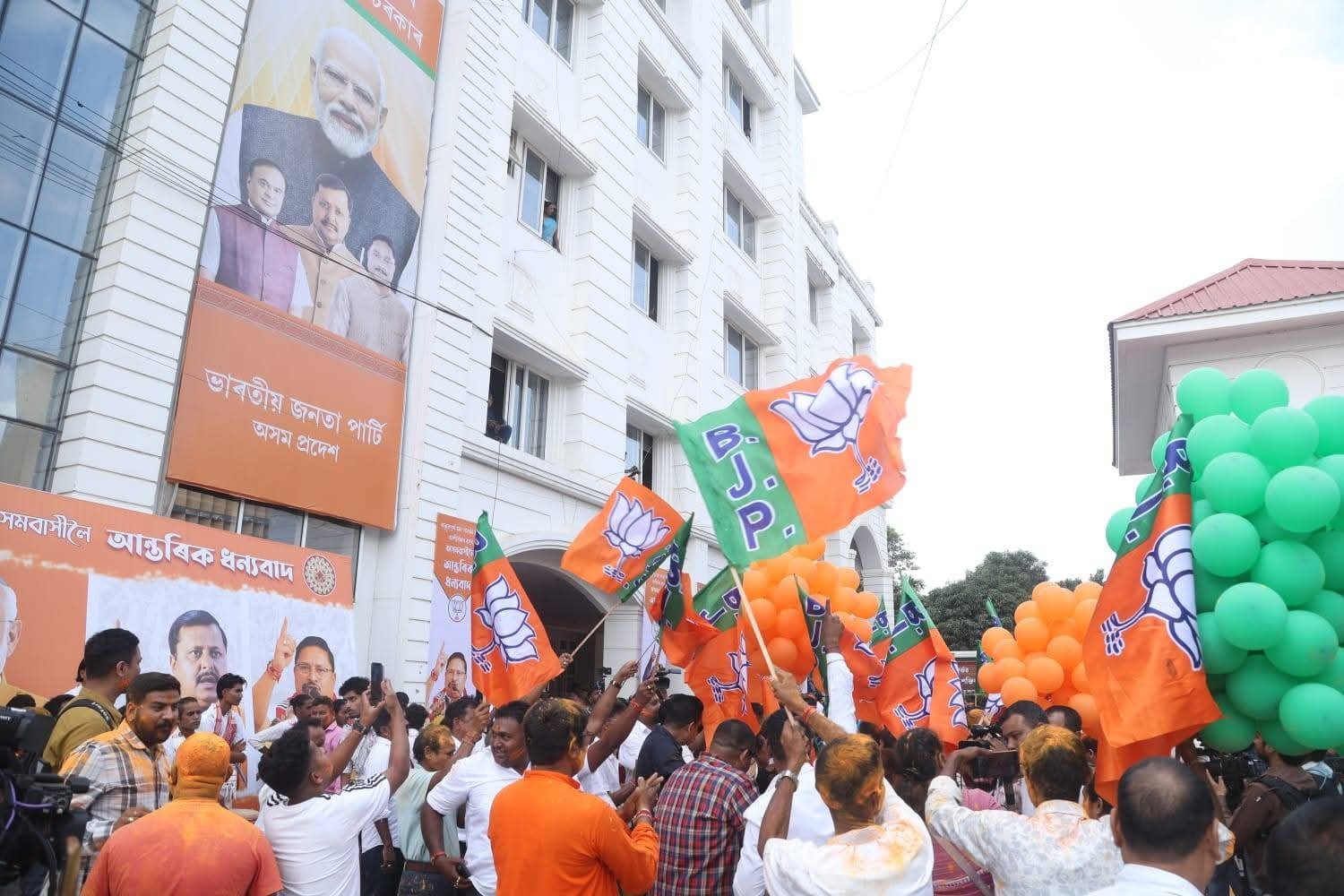
Celebrations erupted across Assam soon after trends became clear. At the BJP headquarters, Atal Bihari Vajpayee Bhawan, party workers celebrated with sweets, slogans, and festivities, while a subdued mood was seen at Congress offices.
Election trends began emerging early in the morning, clearly favoring the BJP. The opposition failed to make significant gains beyond a few minority-dominated constituencies. Even senior Congress leaders, including Gaurav Gogoi and Debabrata Saikia, faced defeats in their respective seats.
A major factor behind the victory was the BJP’s sharp electoral strategy, including constituency delimitation carried out in 2023. The party had earlier predicted crossing 100 seats—a claim that has now turned into reality.
Opposition parties had alleged that the delimitation process reduced the number of Muslim-majority constituencies, weakening parties like the AIUDF led by Badruddin Ajmal.
The BJP government’s welfare schemes played a significant role in building voter support. Key initiatives included:
- Orunodoi Scheme – Monthly financial aid to women
- Mahila Udyamita Scheme – Financial support for women entrepreneurs
- Nijut Moina Scheme – Support for girls’ education
- Free Admission Scheme – Assistance for economically weaker students
In addition, infrastructure development, transparent job recruitment, and governance reforms strengthened public trust. Support from the Rashtriya Swayamsevak Sangh (RSS) also helped consolidate the party’s grassroots network.
This marks the first time in Assam’s history that a non-Congress government has achieved three consecutive terms. Earlier, the Congress under Tarun Gogoi had secured three back-to-back victories between 2001 and 2011.
The BJP first came to power in 2016, retained it in 2021, and has now completed a hat-trick in 2026—firmly establishing its dominance in Assam politics.
The 2026 Assam Assembly election results signal a major political shift in the state. With a strong mandate, the BJP-led NDA is now set to continue its governance with renewed confidence, while the opposition faces the challenge of rebuilding its base in the years ahead.