


During my formative engagements in Sonitpur, Assam, there was a moment that has stayed deeply instructive. A farmer greeted us with a fist of rice grains, uneven in size, some darker than others, catching the sunlight in unexpected ways. What stood out was his quiet explanation: these were not his best grains; those had already been set aside for the next planting cycle. In that simple act lies a profound principle, what is saved versus what is sold often reflects a deeper agricultural intelligence than many formal development interventions capture.
This is what seed banking represents, not merely a technical concept, but a living, evolving practice embedded in India’s agrarian systems, especially across the Eastern Himalayan region where more than 80 percent of farmers are smallholders. Each year, farmers make a deliberate choice to hold something back, reinforcing continuity over extraction. It is a system rooted in cyclical thinking, where sustainability is not an outcome, but a way of life.
Naturenomics™ offers a useful lens to understand this system more fully. It is an economic framework that recognizes the interdependence between nature and the economy, placing the value of natural capital such as land, water, biodiversity, and ecosystems, at the center of decision-making. In this view, the farmer’s decision to save seeds is not an act of foregone profit, but an investment in resilience, biodiversity, and future productivity. What appears economically invisible in conventional systems – diverse seed varieties, soil health, adaptive knowledge, becomes central within a naturenomics™ framework. It is a reminder that economies embedded within nature operate on principles of renewal, interdependence, and continuity, rather than extraction alone.
Across decades of engagement with forests and farms in Northeast India, one observes communities sustaining crop varieties that often elude scientific classification. Rice that withstands erratic monsoons. Millets that thrive in acidic soils. Beans that nourish both livestock and households. These are not isolated examples but embedded adaptive strategies, refined through generations of observation, selection, and resilience.
Seeds, in this sense, carry memory in ways data cannot. They encode droughts, floods, pests, and the labour of countless generations. When these seeds are lost, what disappears is not just a crop variety, but a living dialogue with history, adaptability, and self-reliance. This is where the crisis quietly unfolds. The shift toward hybrid seeds often begins with promise—higher yields in the initial cycles. But over time, dependencies deepen. These seeds demand specific inputs—fertilizers, pesticides, irrigation patterns, often misaligned with changing ecological realities.
When climate variability intensifies or soils degrade, these systems reveal their fragility. Farmers are left without adaptive buffers, drawn into cycles of repeated purchase and rising debt.
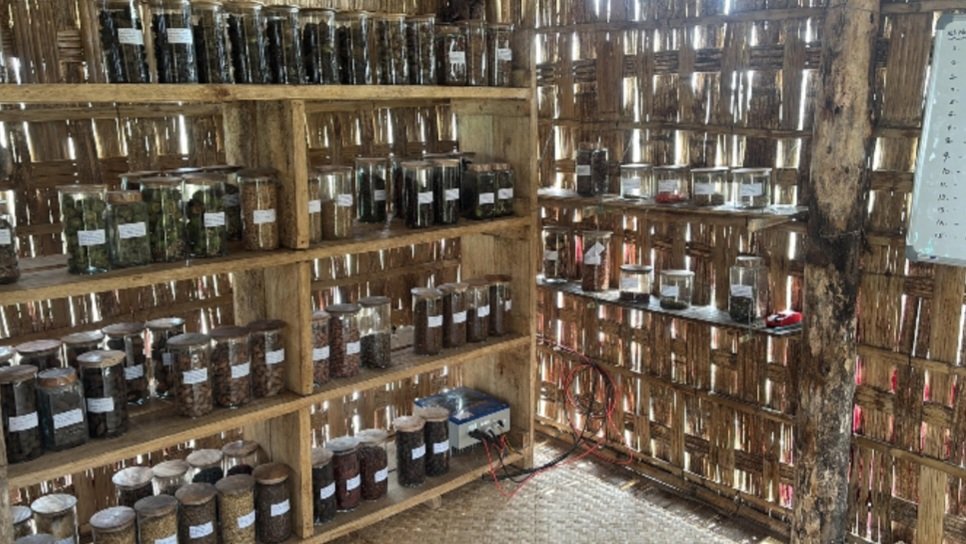
What erodes here is not just soil health, but decision-making autonomy. Community seed banks offer a critical intervention in this trajectory. They are not relics of tradition, but strategic infrastructures of resilience. Functioning as repositories of adaptation, they enable farmers to respond dynamically to shifting climate conditions. Some seeds endure drought; others tolerate heat or excess moisture. In this diversity lies a decentralized but highly effective response system to uncertainty.
A well-functioning community seed bank curates not just seeds, but knowledge, when to plant, how varieties behave, and what conditions they are suited for. In an era of increasing climate unpredictability, this diversity is not optional. It is foundational to survival. Beyond resilience, these systems restore something more fundamental: dignity, sovereignty, and self-reliance. Seed sovereignty is not abstract, it is the ability to make decisions about one’s land, crops, and future without external dependency. Farmers who retain control over their seeds often demonstrate greater confidence in experimentation and risk-taking, grounded in local knowledge systems.
Even in difficult seasons, they are not entirely at the mercy of markets or external inputs.
This autonomy stands in contrast to industrial agricultural models. When seeds are patented, cannot be replanted, or require purchased inputs, farming shifts from stewardship to dependency. The farmer transitions from being a knowledge-holder to an end-user within a larger system.
The ecological consequences further compound this challenge. Monocultures, by design, lack resilience. They simplify ecosystems, degrade soils, and remain vulnerable to pests and shocks.
In contrast, traditional systems embrace multiplicity. A field becomes a living ecosystem, interconnected, adaptive, and responsive to micro-conditions. These systems endure not because they resist change, but because they evolved within ecological limits rather than against them. Yet, many indigenous seed varieties are disappearing, not due to inferiority, but because they remain invisible to market systems. Their localized specificity makes them unsuitable for large-scale uniform supply chains. As these varieties fade, so does the knowledge embedded within them, often irreversibly.
Community seed banks act as safeguards against this erosion. But more importantly, they function as decentralized laboratories of resilience and innovation. They demonstrate that solutions to global food security do not emerge solely from centralized systems or technological scaling, but from communities deeply attuned to their environments. This is the paradigm shift required. Not a rejection of science, but a rebalancing of where knowledge is sourced and valued. Not the pursuit of uniformity, but the recognition of diversity as strength. And most critically, a reframing of farmers not as beneficiaries of development, but as leaders, innovators, and custodians of knowledge systems.
Global food security must therefore be approached through strengthening local agency, through communities that retain control over their seeds and futures. The work itself may appear unassuming, village meetings, seed exchanges, seasonal decisions, but it represents one of the most critical frontiers of agricultural leadership today. The seeds remain. The knowledge endures. What is required now is collective humility to listen, institutional willingness to learn, and sustained commitment to support communities in safeguarding what has always been theirs.
Ranjit Barthakur, Founder Forester, Balipara Foundation