





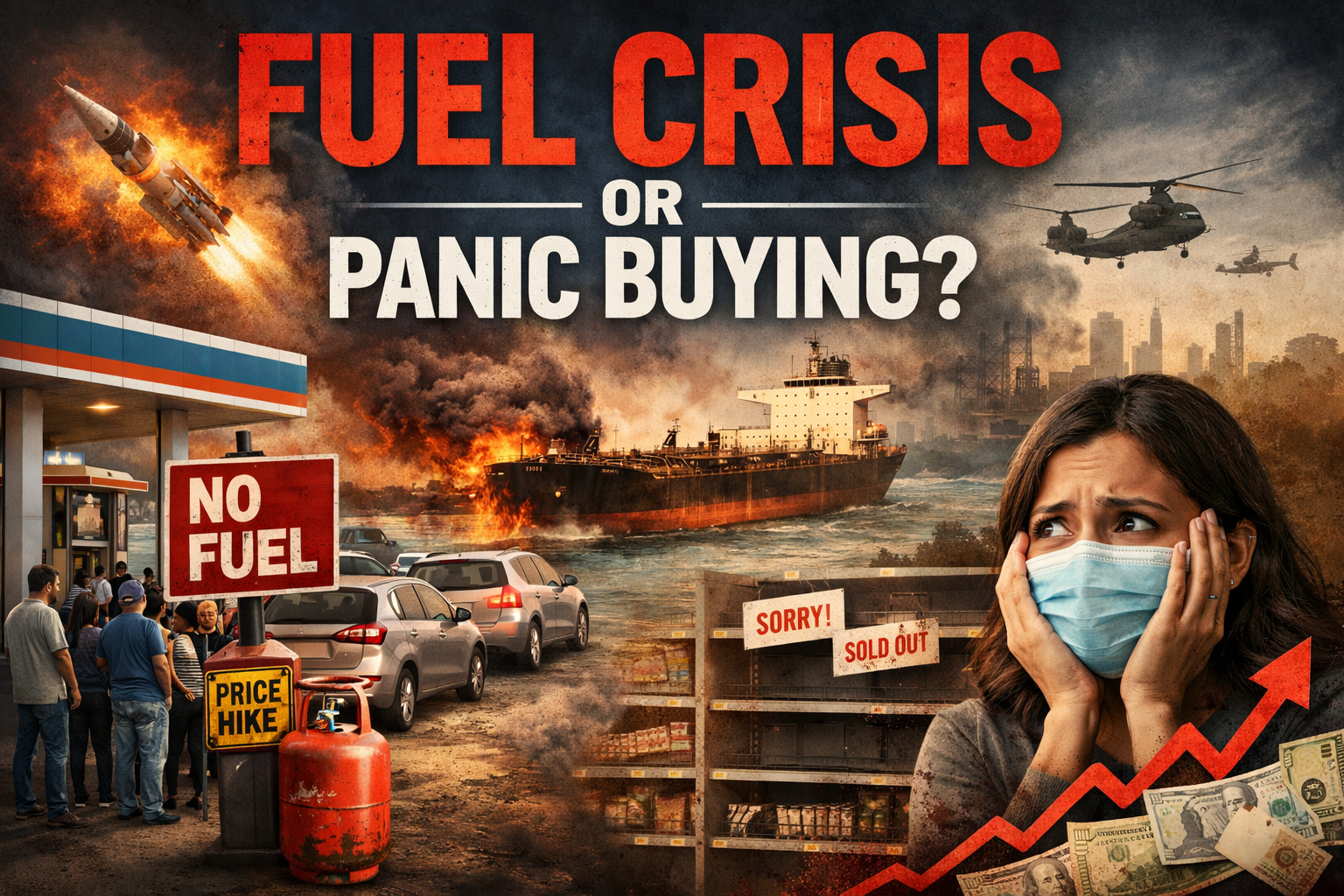
Even as the government repeatedly assures that the country has sufficient reserves of petroleum products and cooking gas, the sudden and unusual rush at petrol pumps across different parts of Assam has naturally caused concern and anxiety among the public. Whenever long queues appear for essential commodities that sustain everyday life, people instinctively begin to wonder whether a deeper crisis is looming behind the scenes. It is therefore natural that a question is now arising in the minds of many citizens: Is the country heading towards another crisis similar to the uncertainty experienced during the COVID-19 pandemic?
The geopolitical tensions in the Middle East have already crossed the one-month mark since the conflict involving Israel, Iran, and the United States intensified on February 28. Although these developments are unfolding thousands of kilometres away from India, the realities of globalization mean that political instability in one region can quickly affect economies and daily life across the world. The unusually long queues and crowds now visible at petrol pumps in Assam appear to be a direct reflection of this global interconnectedness.
Even minor tremors in global geopolitics can significantly impact the economy of a developing country like India, which remains heavily dependent on imported crude oil. A substantial portion of India’s energy needs is met through imports. Consequently, any conflict, tension, or potential disruption in supply from the Middle East immediately creates uncertainty in the international oil market. Such uncertainty often translates into public anxiety, which in turn fuels what economists describe as “panic buying.”
The sudden rush seen at petrol pumps across Assam over the past few days seems largely driven by this psychological fear rather than by any actual shortage. Under normal circumstances, if a consumer requires fuel worth ₹100 for a day, they would simply purchase that amount. However, when uncertainty spreads, many begin filling fuel worth ₹200, ₹300, or even ₹500 at once in anticipation of a possible shortage. A similar pattern is emerging with LPG cylinders as well. Even households that already have one cylinder at home are attempting to stock additional cylinders. Such behaviour inevitably creates an artificial shortage in the market.
At the centre of this entire situation lies one of the world’s most crucial maritime trade routes—the Strait of Hormuz. A significant portion of the world’s crude oil shipments pass through this narrow waterway, and a large share of India’s oil imports also travels along this route. Therefore, even minor tensions in this region can immediately influence global oil prices and supply chains. Recent reports suggesting that Iran may keep the route open for friendly nations provide some relief for countries like India. Nevertheless, fluctuations in global oil supply and pricing are almost certain to affect domestic markets.
Fuel prices have already begun reflecting this uncertainty, with premium petrol witnessing price increases. The rise in fuel prices is never limited to a single commodity; its ripple effects extend across almost every sector of the economy. Transportation systems depend heavily on fuel. As a result, any increase in the price of petrol or diesel eventually raises the cost of vegetables, food items, construction materials, medicines, and other essential goods. Such inflation inevitably increases the cost of living and places the greatest burden on lower- and middle-income households.
Memories of the economic distress experienced during the COVID-19 pandemic are still fresh in the minds of many citizens. Lockdowns, job losses, and disruptions to income sources pushed numerous families into prolonged financial hardship. It is therefore understandable that even a hint of a potential crisis makes people more cautious—and sometimes excessively anxious.
In this complex situation, the role of the government becomes critically important. Ensuring transparent communication and providing accurate information to the public must be a top priority. If the country indeed possesses adequate fuel reserves, that message must be conveyed clearly and consistently to reassure citizens. At the same time, authorities must remain vigilant against hoarding and take strict measures to prevent practices that disrupt the supply chain.
At the same time, citizens too carry a social responsibility. Stockpiling essential commodities based on rumours or unfounded fears only creates artificial shortages that harm society as a whole. Such behaviour disrupts the natural balance of supply and demand, and in the end, it is the common people who suffer the most.