


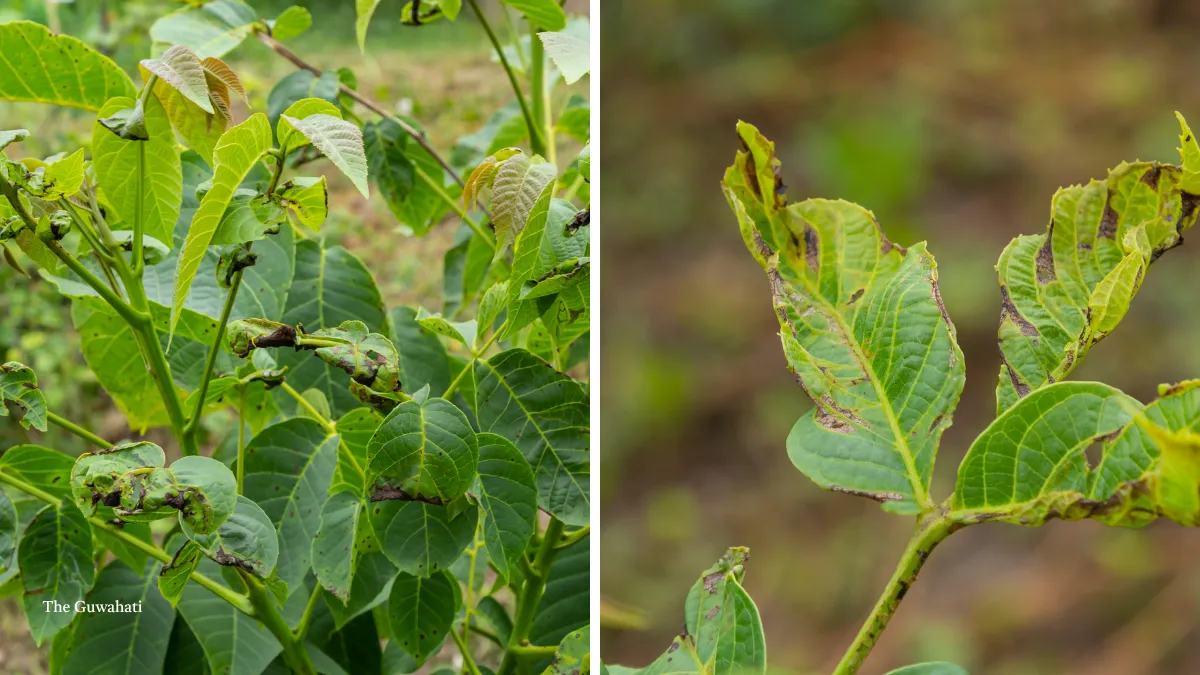



Researchers from the Institute of Advanced Study in Science and Technology (IASST), Guwahati, have identified a fungal pathogen responsible for dieback disease in Indian tea plants and discovered a promising bacterial strain that could help control the infection.
The research, led by Prof. Debajit Thakur, Head of the Life Sciences Division at IASST, has confirmed the first occurrence in India of Lasiodiplodia pseudotheobromae as a causal agent of dieback disease in tea (Camellia sinensis).
The findings were published in October in the internationally recognised European Journal of Plant Pathology, published by Springer Nature. The investigation was conducted at Konapathar Tea Estate in Tinsukia district of Assam.
During the study, the research team isolated a fungal strain, named GHK1, from infected tea leaves. The researchers used morphological examination and molecular identification techniques involving three genetic markers — ITS, TEF-1α and β-tubulin — to identify the fungus as Lasiodiplodia pseudotheobromae.
Laboratory experiments further established its role in causing the disease. The fungus was able to reproduce characteristic dieback symptoms in healthy tea leaves and plants, confirming its ability to cause the infection.
The discovery is significant because tea dieback disease in India has traditionally been associated mainly with Fusarium species. The identification of another fungal pathogen adds to the scientific understanding of diseases affecting tea plantations and points to the need for broader disease-management approaches.
Bacterial strain shows potential to control tea disease
Alongside identifying the pathogen, the researchers discovered a beneficial soil bacterium, Streptomyces sp. A2, which demonstrated promising antifungal properties.
Laboratory tests showed that the bacterial strain inhibited the growth of Lasiodiplodia pseudotheobromae by 83.33 per cent. The bacterium also displayed plant growth-promoting characteristics, including phosphate solubilisation, ammonia production and potential nitrogen fixation.
Researchers believe the strain could form the basis of an indigenous biological control technology for managing tea dieback disease.
Its ability to suppress the fungal pathogen while also supporting plant growth makes it a potential candidate for more sustainable tea cultivation. Such a biological approach could eventually help reduce dependence on chemical fungicides.
However, the researchers noted that further greenhouse and field trials would be necessary to establish its effectiveness under actual plantation conditions and develop a suitable biocontrol formulation.
The findings could have wider relevance for Assam’s tea industry, where disease management and sustainable plantation practices remain important concerns. The research also highlights the potential of locally identified microorganisms in developing environment-friendly solutions for crop protection.