


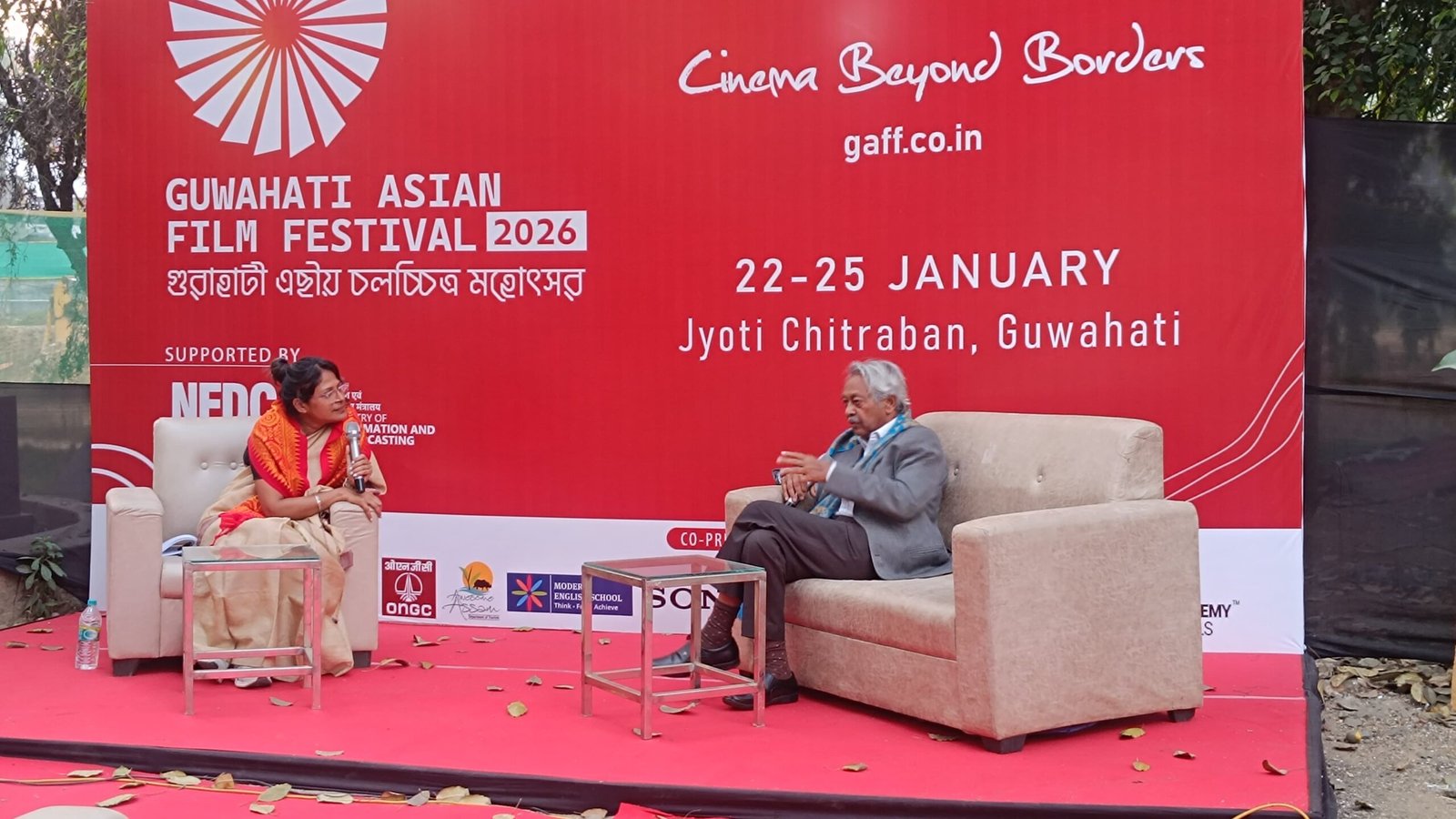
Guwahati: Legendary Indian filmmaker Girish Kasaravalli engaged film enthusiasts, students and independent filmmakers during an enriching interactive session titled “The World of Girish Kasaravalli – An Interaction with the Master Filmmaker” at the second edition of the Guwahati Asian Film Festival (GAFF).
Moderated by acclaimed Assamese filmmaker and writer Reema Borah, the session explored cinema as a philosophical, cultural and social medium, moving beyond surface aesthetics and conventional commercial definitions of filmmaking.
Emphasising the role of film festivals in nurturing cinematic literacy and meaningful dialogue, Kasaravalli said film festivals remain the only spaces where filmmakers and audiences can truly interact.
“Film festivals play a major role because this is the only forum where filmmakers and audiences can truly interact. It is also the only space where you look beyond the plot. Plot is not the film—discourse is the film,” he said.
Renowned for landmark works such as Ghatashraddha, Thaayi Saheba, Dweepa, Hasina and Naayi Neralu, Kasaravalli spoke about cinema as a form of quiet resistance and introspection rather than spectacle. He stressed that authenticity, moral complexity and cultural rootedness are essential to impactful filmmaking, adding that stories achieve universality when they arise from deeply local realities.
Reflecting on the creative process, Kasaravalli underscored the importance of ideas and philosophy over technical obsession.
“People often mistake information for knowledge and then try to create art. Cinema has a philosophy behind technique. It is not about what lens looks good; it is about what idea the image communicates,” he noted.
The interaction also covered evolving cinematic grammar, mentorship, casting discipline and the responsibility of filmmakers to remain intellectually honest in an era defined by rapid technological change and information overload.
Reema Borah guided the conversation through Kasaravalli’s formative influences, including his association with theatre and film stalwart B.V. Karanth, and how those early collaborations shaped his understanding of performance, narrative structure and collaborative filmmaking.
The session saw strong participation from cinephiles and film students, with questions on visual aesthetics, storytelling choices and the future of parallel cinema in the OTT era.
The interaction aligned with GAFF’s broader objective of fostering meaningful engagement between industry professionals and emerging talent, strengthening regional film culture and encouraging deeper cinematic discourse.
The second edition of the Guwahati Asian Film Festival was organised by Trending Now Media, with support from the National Film Development Corporation (NFDC) and the Ministry of Information and Broadcasting, Government of India.