

Balipara Foundation Honours the Guardians of the Eastern Himalaya
In the heart of the Eastern Himalaya, where forests breathe, rivers remember, and mountains stand as silent witnesses to centuries of life, a quiet revolution is happening. It is not led by politicians or corporates sitting in air-conditioned offices. It is led by forest guards who walk miles in the rain, teachers who plant ideas along with trees, farmers who protect the soil, young naturalists who dream of a greener tomorrow, and village women who have turned conservation into a livelihood. And once a year, the Balipara Foundation brings them all together on one stage to say two simple words – Thank You.
The 14th edition of the Balipara Foundation Awards 2026 was not just an awards ceremony. It was a celebration of those who are saving nature, not with speeches, but with their lives. It was a gathering of conservation practitioners, community leaders, educators, researchers, environmental storytellers and institutions from across the Eastern Himalaya and neighbouring countries – all united by one belief: that communities and nature must be at the centre of sustainable development. This year’s recipients represented a diverse range of conservation efforts, from grassroots forest protection and wildlife safeguarding to regenerative landscapes, traditional knowledge systems, cultural preservation, environmental education and nature-positive enterprises.
The Heroes Who Healed the Land
The evening began with honouring those who are healing the earth itself. The Regenerative Landscapes Award was presented to the Elopa-Etugu Eco-cultural Preserve (EECEP) – an initiative that has shown how damaged landscapes can be brought back to life when ecological restoration is combined with cultural respect and community ownership. From Bhutan, Chogyal Lamo was honoured with the prestigious Naturenomics Award – the Foundation’s signature recognition for those who place nature at the heart of economic thinking. The Earth Storyteller Award was presented to Abhaya Raj Joshi of Nepal, whose stories have carried the voice of the Himalaya, its wildlife, and its people to the world. In a time when climate change is often reduced to data and graphs, his storytelling reminds us that conservation begins with emotion. From the Sikkim-Darjeeling Himalaya, Priyadarshinee Shrestha received the Green Teacher Award for her remarkable contribution to environmental education. Her work proves that the biggest change does not always begin in a forest – it often begins in a classroom, with a teacher who inspires a child to love a tree. The future was also celebrated with great hope. The Young Naturalist Award recognised Sara Khongsai, Pemba Tsering Romo and Dechin Pema Saingmo, acknowledging the importance of nurturing the next generation of conservation leaders. Their energy, curiosity and commitment showed that the Eastern Himalaya is in safe hands.
The Frontline Warriors Who Guard the Forest
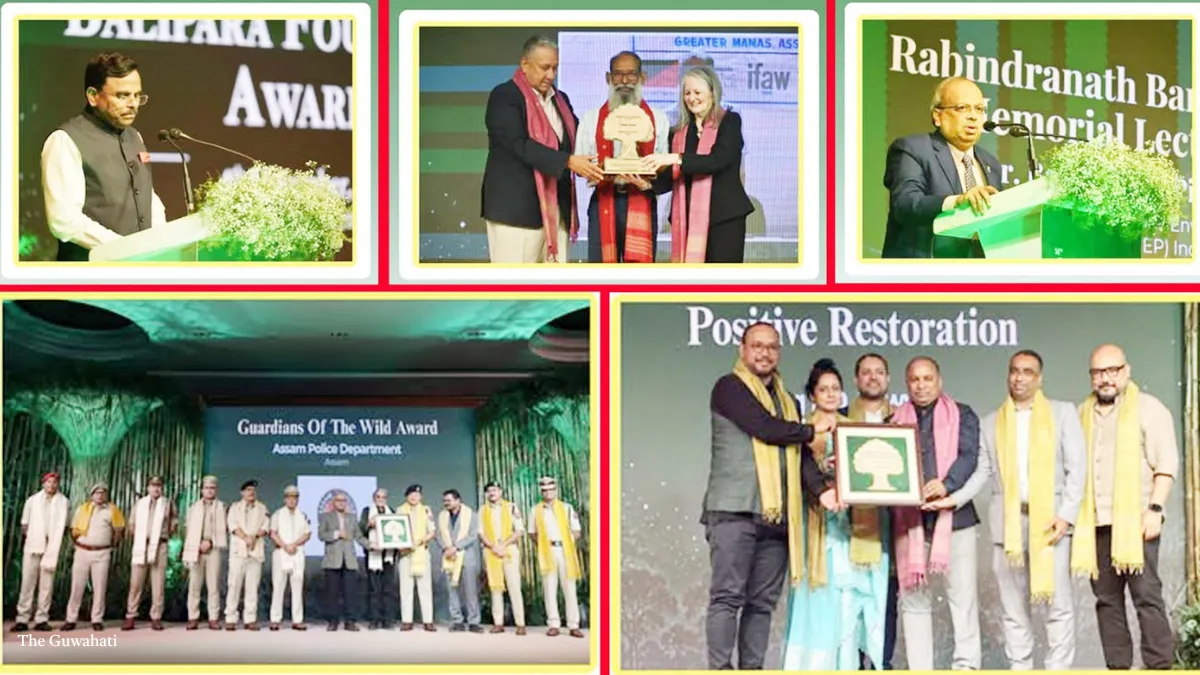
No conservation story is complete without the men and women who stand in the forest, day and night, often risking their lives. Recognising the critical role of institutional commitment and frontline protection, the Assam Police Department received the Special Recognition Award for Excellence in Wildlife Protection and Anti-Poaching. Their work has been crucial in the fight against poaching and wildlife crime in Assam, home to the world-famous one-horned rhinoceros and Asian elephants. The Forest Guard & Rangers Award honoured Debashree Bhuyan, Jantu Choudhury, Kiran Chandra Basumatary and Pranjal Talukdar for their tireless contributions to forest protection. These are the names that rarely make headlines, but without them, there would be no forest left to protect. The 134 Infantry Battalion (Territorial Army) Ecological was recognised with the Eco Task Force Award for its dedicated work in ecological restoration and protection. Their discipline, teamwork and commitment have turned barren lands into green zones.
When Communities Lead, Nature Thrives
The awards also highlighted the importance of community-led conservation and sustainable livelihoods – the idea that people do not have to choose between protecting nature and earning a living. Chibasal SHG from Meghalaya received the Food for the Future Award for its work in sustainable food systems and community nutrition. The group has shown how local food, traditional knowledge and women’s leadership can build a food-secure future. The Manas Mozigendi Ecotourism Society was awarded the Rewilding Grant for its conservation and ecotourism initiatives in the Manas landscape. By linking tourism with conservation, the Society has created livelihoods while also protecting one of India’s most precious wildlife habitats. Larsing L.D. Sawyan and Kaziranga Heritage received the Special Recognition – Naturenomics Award for Nature-Positive Restoration, honouring their work in restoring landscapes in and around Kaziranga – a UNESCO World Heritage Site and a symbol of Assam’s natural pride.
Culture, Elephants and a Lifetime of Service
In recognition of the role of cultural heritage in ecological stewardship, Seela Lepcha of Sikkim received the Eastern Himalayan Cultural Inheritance Award. Her work reminds us that in the Himalaya, culture and nature are not separate – songs, rituals, festivals and forests are all part of the same story. Dr. Khyne U Mar of Myanmar was honoured with the Special Recognition Award – The Elephant Guardian for her extraordinary contribution to elephant conservation. In a region where elephants face habitat loss and human conflict, her work stands as a beacon of compassion and science. The Lifetime Service Award was conferred upon Bhupendra Nath Talukdar, recognising his enduring contribution to conservation. It was a moment of standing ovation – a lifetime spent in service of nature, finally honoured on a stage that he helped build through his example. The Trunk Tales Award recognised Mayank Jaiswal, Himadri Bhuyan and Nipun Raj for their creative work in communicating elephant conservation to new audiences. The Naturenomics Pitch category recognised a new wave of young innovators – Thenhoi Kipgen, Himangshu Kalita, Mrigakshee Phookan, Akash Dilip Kamble, Bhaskar Jyoti Parasar and Priyanku Sarma – who presented nature-positive ideas and enterprises that can change the future of the region.
A Stage Shared With Global Leaders
The awards were presented by distinguished conservationists, environmental leaders and institutional representatives, including Dr. Meg Lowman, CEO of TREE Foundation; Rohit Anand, Founder of WondrBridge; Dr. Barkha Subba; Vaswati Sharma Barthakur of Tata Electronics; His Eminence Palga Rinpoche; Bittu Sahgal, Founder of Sanctuary Nature Foundation; Dasho Paljor Benji Dorji; Babita Baruah; Dr. P. Balakrishna, Head of UNEP India; Sangeeta Goswami, Educationist USA ; Chacko Thomas, Chief Sustainability Officer, Tata Sons; Heidi Riddle, Chair of the IUCN SSC Asian Elephant Specialist Group; Dr. Ravi Kota, Chief Secretary Assam ; Debajit Saikia, Secretary of BCCI ; Radhika Barthakur; Ranjit Barthakur; and Purnima Devi Barman. Their presence showed that the Balipara Foundation Awards are no longer just a regional event. They have become a global platform where the Eastern Himalaya speaks to the world.
More than Awards – A Movement
The Balipara Foundation Awards remain an important platform for recognising and amplifying efforts that demonstrate how ecological conservation, cultural continuity and community well-being are deeply interconnected. By bringing together changemakers from across the region and beyond, the awards seek to strengthen a growing network of individuals and institutions working towards a nature-positive future for the Eastern Himalaya. The 14th edition reaffirmed the Foundation’s commitment to advancing Naturenomics – an approach that places nature at the heart of economic and developmental thinking – and to recognising those translating this philosophy into meaningful action on the ground. As the evening ended, one message stayed with everyone: When communities protect nature, nature protects communities. And in the Eastern Himalaya, that protection is happening every single day – in forests, in classrooms, in villages, and in the hearts of people who refuse to give up on nature.